
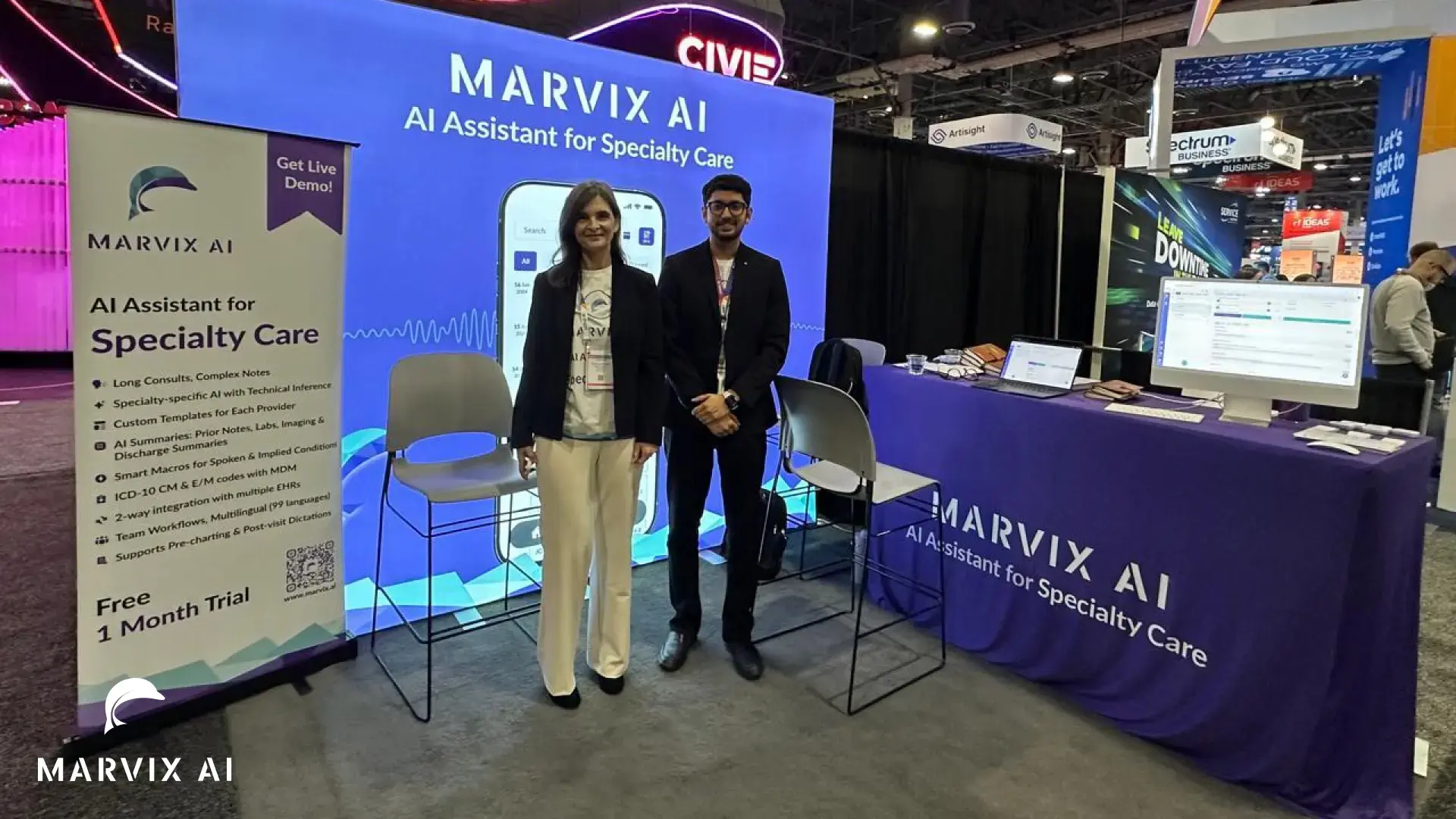

A year ago, ambient AI conversations at health system events were broad and exploratory. This year in Las Vegas, people were showing up with receipts. A lot of people had already run pilots and wanted to talk about where specialty care was still slipping through.
We also started noticing a shift in who we were speaking with. Many of the conversations were with CIOs, CMOs, and similar roles representing 20 to 40 provider groups, looking at how something like this would actually roll out across a practice.
Specialty care runs on longitudinal context, and assembling that context accurately is a harder problem than most ambient AI solutions have solved for. A patient's history sits across prior notes, imaging, and outside records, and documentation built only from today's encounter tends to leave coding accuracy and claim outcomes exposed in ways that surface slowly.
What struck us at HIMSS was how precisely people could describe this.

By the end of most conversations at the booth, the question had shifted from what Marvix does to how quickly it could be up and running. In most cases, this was coming from teams thinking about rollout across multiple providers, which is where integration and workflow questions started to matter more.
If there are two-way EHR integrations for example with Advanced MD, eClinicalWorks, Veradigm, Athenahealth, and other major systems, how data is pulled and how it is pushed back into the EHR. The real-time collaboration across physician and medical assistant roles within the same note also drew interest, particularly from people with bigger teams
HIMSS 2026 made something clear about where ambient AI in specialty care is heading. Health systems are now asking whether the technology works specifically for the complexity of specialty workflows, and that's a meaningfully different question from where the conversation was a year ago. The people walking the floor had already done one round of evaluations and arrived knowing exactly where those fell short. That made the conversations at our booth feel less like introductions and more like a continuation of something already in progress.
Want to see how Marvix AI handles specialty documentation? We offer a 30-day free trial of Marvix AI, integrated with your EHR from day one, for your entire team.
.png)


