Nephrologists spend a large part of each day documenting complex care. Every visit includes CKD stage, dialysis updates, and detailed lab trends. Notes often happen after the visit ends. That delay adds cognitive load and increases the risk of missed details. Over time, documentation becomes a second shift.
AI tools now change how these notes get written. An AI scribe for nephrologists can capture the visit and turn it into structured output in real time. Marvix focuses on nephrology workflows. It tracks CKD progression, summarizes labs, and organizes plans by problem. This guide explains how the best AI scribe for nephrology works, what to look for, and how it fits into daily systems such as eClinicalWorks.
Why Nephrology Documentation Takes So Much Time
Nephrology stands among the most documentation-heavy specialties. Care is longitudinal and data-rich. Each visit builds on years of prior information. That makes note creation slow and cognitively demanding, even for experienced clinicians.
To understand where this time goes, break the workflow into its core documentation tasks:
Long-term tracking of CKD progression across visits Each visit requires comparison with prior eGFR values, staging updates, and progression notes over months or years
Detailed dialysis session documentation with multiple variables Clinicians record access type, session parameters, ultrafiltration volume, vitals, and any complications
Lab-heavy decisions using creatinine, eGFR, and electrolytes Notes must reflect trends across multiple labs, not isolated values, which adds interpretation time
Frequent follow-ups with constant care plan changes Small shifts in labs or symptoms often lead to medication changes and updated plans
Review of external labs and imaging Data from outside systems must be read, summarized, and added into the current note
Coding and compliance requirements Documentation must support E/M levels, CKD staging, and comorbidity capture for billing
What Makes Nephrology Notes More Complex Than Other Specialties
Nephrology notes carry layered clinical reasoning. Each section connects to another, and small changes in labs can shift the plan.
The complexity becomes clear when you look at what each note must account for:
Multiple comorbidities such as diabetes and hypertension These conditions directly affect kidney function and must be tracked alongside CKD
Dialysis modality details such as hemodialysis or peritoneal dialysis Each modality requires different parameters, risks, and documentation styles
Medication changes tied closely to lab values Dosing decisions depend on creatinine, potassium, and fluid status
Ongoing fluid balance tracking and volume status assessment Notes must reflect intake, output, edema, and weight changes
CKD complications such as anemia and mineral bone disorder These require separate assessment and plan sections within the same note
Transplant status and eligibility considerations Some patients require documentation around transplant workup or follow-up care
What Is an AI Scribe for Nephrology and How It Helps
An AI medical scribe for kidney specialists listens during patient interactions and converts that conversation into structured clinical notes. It captures history, lab discussions, and treatment plans without manual typing.
In nephrology, this matters more. The tool must follow detailed lab trends, CKD staging, and dialysis updates without losing context. Strong nephrology documentation software captures conversations and organizes them into structured clinical sections such as history, labs, and assessment and plan. It helps automate nephrology clinical notes with consistent structure and clinical accuracy.
This leads directly to how these tools fit into a typical clinic day..
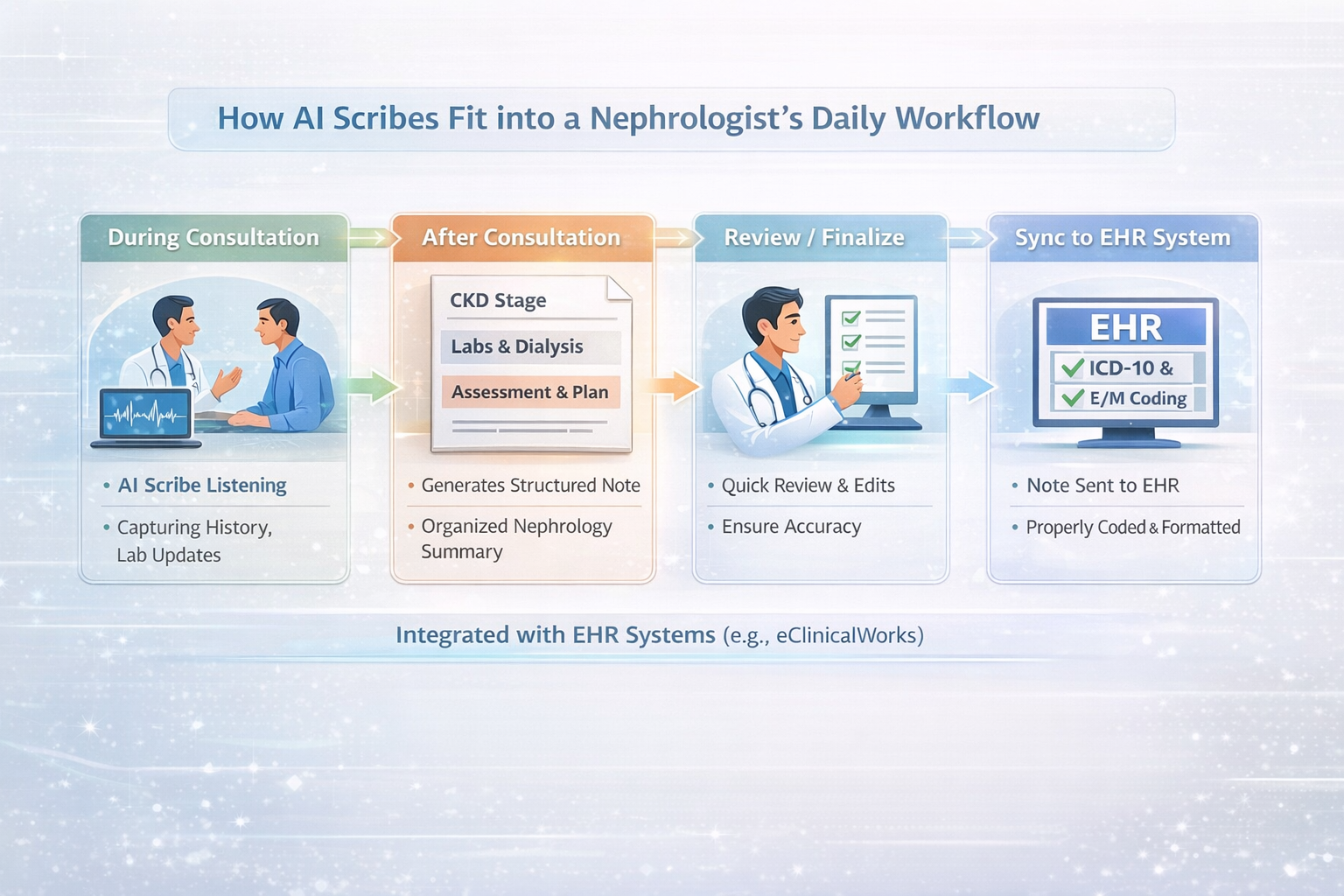
How AI Scribes Fit into a Nephrologist’s Daily Workflow
The workflow fits into the clinic day without adding extra steps.
During consultation: The AI scribe listens in the background as the visit unfolds. It captures history, symptoms, dialysis updates, and lab discussions as they happen. The clinician focuses on the patient instead of the screen.
After consultation: Within seconds, the tool generates a structured nephrology note. It organizes content into sections such as CKD stage, lab trends, dialysis details, and problem-based assessment and plan. The output reflects how nephrologists already document.
Before finalising: The clinician reviews the note with minimal edits. Most of the structure and detail are already in place, so the review focuses on accuracy and clinical nuance rather than rewriting.
Syncs into EHR systems such as eClinicalWorks: The final note flows into the EHR with proper formatting. Coding elements such as ICD-10 and E/M levels are included, which reduces additional documentation work after the visit.
Key Features to Look for in the Best AI Scribe for Nephrology
Not every AI scribe can handle nephrology workflows. Many tools capture conversations but miss clinical structure, lab context, and longitudinal tracking. The best AI scribe for nephrology must match how kidney care is documented across visits.
Use this checklist to evaluate any AI scribe for nephrologists in real clinical settings:
1. Longitudinal History Capture
Nephrology care depends on continuity across months and years. Each visit builds on prior CKD stage, lab trends, and comorbidities. A strong AI scribe for nephrologists should:
Track CKD stage from 1 to 5 using eGFR trends across visits
Auto-tag CKD etiology such as diabetes, hypertension, or glomerular disease
Pull prior notes, labs, and imaging into the current encounter
Show disease progression clearly within the note
This gives the clinician full clinical context without manual chart review.
2. Pre-Charting with Lab and Imaging Summaries
Nephrologists review multiple data points before entering the room. This includes creatinine trends, electrolytes, urine studies, and imaging reports. A capable nephrology documentation software should:
Extract key values from prior lab reports and imaging
Summarize creatinine, eGFR, potassium, and urine findings
Present a concise pre-visit summary for quick review
Insert these summaries directly into the note This reduces pre-charting time and improves accuracy during the consult.
3. Nephrology-Specific Clinical Intelligence
Generic AI tools miss renal-specific details. Nephrology requires precise interpretation of labs, dialysis data, and disease staging. The best AI scribe for nephrology should:
Recognize nephrology terminology and workflows
Capture CKD complications such as anemia and mineral bone disorder
Structure notes around renal problems and treatment plans
Reflect clinical reasoning tied to lab values and progression This level of specificity supports accurate and usable notes.
4. Custom Templates for Each Provider
Each nephrologist follows a preferred note structure. Some focus on problem-based plans. Others prioritize lab summaries or dialysis details. An AI scribe for nephrologists should:
Adapt to individual note formats and section order
Learn provider-specific phrasing and documentation style
Generate notes that match existing templates used in practice This reduces editing time and keeps documentation consistent.
5. Two-Way EHR Integration
Documentation must move between systems without friction. Manual copy-paste creates delays and errors. A reliable AI medical scribe for kidney specialists should:
Sync notes directly into EHR systems such as eClinicalWorks
Pull patient data from the EHR into the note workflow
Link notes to appointments and patient records automatically This keeps documentation aligned with the clinical system of record.
6. Automated ICD-10 and E/M Coding
Accurate coding affects revenue and compliance. Nephrology visits often involve multiple conditions and risk factors. The best AI scribe for nephrology should:
Generate ICD-10 codes based on documented conditions
Assign CPT and E/M levels using MDM logic
Flag risk factors and apply correct modifiers
Include coding rationale within the note This reduces undercoding and supports audit readiness.
7. Multi-Language and Multi-Speaker Support
Real-world consultations include patients, caregivers, and staff. Conversations often switch between languages and speakers. An effective AI scribe for nephrologists should:
Capture multiple speakers within a single visit
Handle different accents and speech patterns
Support multilingual conversations during documentation This improves capture accuracy in diverse clinical settings.
8. After-Visit Documentation and Letters
Documentation extends beyond the clinical note. Nephrologists generate multiple follow-up documents after each visit. A complete nephrology documentation software should:
Generate after-visit summaries (AVS)
Create referral letters and consultation notes
Support prior authorization documentation
Produce post-procedure or follow-up notes This reduces administrative work after clinic hours.
9. Team-Based Workflow Support
Nephrology care involves a team. Medical assistants, nurses, and physicians contribute to documentation at different stages. The best AI scribe for nephrology should:
Allow MAs to assist with pre-charting and intake data
Enable nurses to add history and vitals
Let physicians focus on assessment and plan
Track contributions across users in real time This supports collaborative documentation without duplication.
10. Seamless EHR Sync and Continuity
Continuity across visits is critical in CKD management. Notes must carry forward relevant history and plans. An advanced AI scribe for nephrologists should:
Carry forward prior assessments and treatment plans
Maintain continuity across follow-ups
Sync updates in real time with the EHR This keeps documentation aligned with disease progression.
11. Pre and Post-Visit Dictation Support
Not every detail gets captured during the consultation. Clinicians often add context before or after the visit. A flexible AI medical scribe for kidney specialists should:
Allow recording before the consult for pre-visit thoughts
Capture post-visit dictation for additional details
Merge all inputs into a single structured nephrology note This gives clinicians full control over documentation.
Marvix CTA button:
Marvix brings all these capabilities into one workflow. Book a quick demo to see how it simplifies nephrology documentation from consult to coding.
Marvix AI
Marvix brings all these capabilities into one workflow. Book a quick demo to see how it simplifies nephrology documentation from consult to coding.
Using an AI Scribe with EHRs in Nephrology Workflows
Many nephrology practices use Epic to manage CKD follow-ups, dialysis care, and longitudinal patient records. Epic follows a structured documentation model, where notes are organized into sections such as HPI, labs, and assessment. This structure requires information to be placed correctly within the system, which adds time to documentation.
Marvix works within this setup as an AI scribe for nephrologists. It captures clinical conversations and converts them into structured nephrology notes that align with Epic documentation. It uses existing patient data and maps new information into the appropriate sections, so documentation fits into the system without changing how clinicians work.
Here is how documentation happens in a nephrology clinic using Marvix:
During the consultation Marvix listens to the interaction and captures CKD stage, symptoms, dialysis details, lab discussions, and treatment plans. It records the full clinical context, including multiple speakers.
After the consultation Marvix generates a structured note with CKD stage, eGFR trends, comorbidities, dialysis data, and treatment plans organized into sections such as HPI, labs, assessment, and plan.
Before finalising The clinician reviews the note. Prior context such as lab trends, CKD progression, and treatment history is already reflected, so the review focuses on accuracy and small edits.
Final note in the EHR The note is entered into the EHR and aligned with its section-based structure. Each section is placed into the relevant fields, so the note is ready for sign-off without additional formatting.
This workflow shows how Marvix supports nephrology documentation software in automating clinical notes within EHRs while keeping documentation structured and aligned with existing clinical workflows.
What Changes When You Use the Best AI Scribe for Nephrology
Nephrology documentation shifts from a delayed, manual task to a structured, real-time workflow. The change shows up across the entire clinic day, from how notes are created to how time is spent with patients.
Before using an AI scribe for nephrologists:
Writing notes after clinic hours, often reconstructing visits from memory
Switching between screens to review labs, prior notes, and imaging
Manually placing information into EHR sections such as HPI, labs, and assessment
Recalling CKD progression, dialysis details, and treatment history during documentation
Reviewing years of prior notes and labs before each visit
Re-entering the same clinical context across follow-ups
Delays between patient interaction and documentation
After using the best AI scribe for nephrology:
Notes generated immediately after each consultation in structured format
CKD stage, lab trends, and dialysis data captured during the conversation
Documentation mapped directly into EHR sections without manual placement
Longitudinal history from prior visits reflected within the note
Pre-visit summaries ready with prior notes, labs, and imaging
Patient context carried forward automatically across visits
Documentation completed within the same encounter window
Reduced back-and-forth with billing due to structured coding support
Multi-user inputs captured in one note without duplication
Now that you understand what to look for in the best AI scribe for nephrology, the next step is choosing a solution that fits directly into your daily workflow.
How Marvix AI Supports Nephrology Documentation Workflows
Marvix is built to handle how nephrology care is documented across CKD follow-ups, dialysis visits, and lab-driven decision making. It captures patient conversations in real time and converts them into structured nephrology notes. Each note reflects CKD stage, eGFR trends, comorbidities, and treatment plans in the correct clinical sections.
For dialysis care, Marvix captures session details such as access type, vitals, ultrafiltration volume, complications, and lab values. This information is organized into the note without requiring manual entry after the visit. For CKD management, it tracks disease progression across visits and reflects prior lab trends and treatment response within the current note.
Marvix fits directly into EHR workflows such as eClinicalWorks, Athena, Veradigm. It syncs appointments, retrieves patient history, and generates notes mapped to the provider’s EHR template. Documentation is placed into the correct sections such as HPI, labs, and assessment at the time of note creation. This removes manual placement and reduces after-hours charting while keeping documentation accurate and complete.
Key capabilities for nephrology documentation:
Captures CKD stage, etiology, dialysis session details and progression across visits
Tracks lab trends including creatinine, eGFR, electrolytes, and urine studies
Generates structured notes aligned with nephrology workflows
Summarises longitudinal data in a chronological order before every visit
Inserts prior data from labs, imaging, and treatment history into current notes
Structures assessment and plan by nephrologic problems
Syncs directly with ECW and maps notes to template sections
See how Marvix fits into your nephrology workflow in minutes. Book a personalised demo to experience faster, more accurate documentation built for CKD and dialysis care.
Final Thoughts
Nephrology documentation involves detailed tracking of CKD stages, lab trends, and dialysis care across multiple visits. This makes note creation time-intensive and mentally demanding. An AI scribe for nephrologists reduces this burden by capturing clinical conversations and converting them into structured notes with accurate lab data and treatment context. The best AI scribe for nephrology fits into existing systems such as Athena or ECW and aligns with how clinicians document care.
If you are looking to spend less time on notes and more time with patients, exploring an AI scribe built for nephrology workflows can be a practical next step. Try Marvix AI’s 30-day free trial today!
FAQs
Is an AI scribe accurate enough for complex nephrology cases?
AI scribes can handle complex nephrology documentation when trained on clinical workflows, but doctors should always review notes to ensure accuracy, especially for lab-driven decisions and treatment plans.
Can AI scribes help with dialysis documentation and follow-ups?
Yes, AI scribes can capture dialysis-related discussions, including fluid status, lab values, and medication changes, and convert them into structured follow-up notes.
Do AI scribes work during patient consultations or after the visit?
Most AI scribes work in real time during consultations, capturing the conversation and generating notes immediately after the visit for quick review and finalisation.
Are AI scribes secure for handling sensitive nephrology patient data?
AI scribes designed for healthcare follow strict data security and compliance standards to protect sensitive patient information, including encryption and secure data handling practices.
How much time can nephrologists save using an AI scribe?
Many nephrologists can significantly reduce documentation time, often saving several hours per week by automating note-taking and reducing after-hours charting.


.png)


