


Walking into a conference floor where every neighbouring booth has multi-panel displays, branded setups, and enough swag to fill a storage unit has a way of sharpening your thinking. We knew what we were there to show. The question heading into Day 1 was whether neurologists would stop long enough to see it.
They did, and the four days that followed were unlike anything we had experienced at a conference before. Over 100 demos across four days meant the booth rarely had a quiet moment, and lunch was something that simply did not happen. What kept us going was coffee, water sipped regularly enough to keep our voices from giving out, and the physicians themselves, whose enthusiasm and genuine curiosity made every conversation feel worth staying for.
The demos went deep too, with physicians actively testing real clinical scenarios at the booth rather than just watching. One pediatric neurologist ran a live case for over thirty minutes, reviewing the output line by line, challenging every section. Marvix AI held up across all of it, and by the end he said he was taking it to his administration to set up a full technical evaluation and signed up for a trial before leaving.
Residents who were weeks away from starting independent practice wanted to get set up before their first day. Physicians who had flown in from other countries wanted to know when Marvix would be available in theirs. By the time AAN wrapped, here's what we took away from those conversations.

We expected to spend time explaining the category. Nearly every neurologist who stopped had already been using an AI scribe, so conversations started further along. They had opinions and were ready to share them.
Pre-charting was where the conversations went deepest. Physicians described spending the first few minutes of every appointment catching up on a patient's history while the patient sat waiting. Where a condition stood relative to prior visits, what medications had changed, what the last few notes said. For most, this was an accepted part of how neurology practice runs.
The Patient Recap in Marvix AI is built for exactly that. It pulls prior notes, medication regimens, lab results, and imaging reports from the EHR and organises everything into a structured summary before the visit starts, so the physician walks in already oriented. The summary is also adjustable, with one provider preferring a short scannable version and another wanting a detailed longitudinal view across the patient's full history. Showing this live, with the actual output on screen rather than just describing the concept, changed the tone of conversations more consistently than anything else we demoed at AAN.
Transcription quality did come up, and the feedback was largely consistent. Transcription was mostly fine. The note that came out afterward still needed editing, and that editing was consuming the time physicians had expected to get back. A few described rewriting whole sections from scratch. The scribe had shifted the documentation burden without actually reducing it, and that frustrated physicians who had already put in the work of adopting something new.
Capturing what was said in an encounter is a different problem from producing a clinical note that reflects how a specialty physician actually documents. Marvix AI builds specialty and disease-specific templates across neurology, with structured sections for history, exams, diagnostics, assessment, and clinical reasoning that reflect how a neurologist actually moves through a case.
Beyond the specialty level, each individual provider gets their own templates built through neural style transfer, where Marvix AI learns from a physician's prior documentation and replicates their tone, phrasing, formatting, and section ordering. The note that comes out feels like that physician wrote it because in the ways that matter, they did.
Paediatric neurology is worth naming specifically here because the workflow differs substantially from adult neurology, with multiple questionnaires per visit, age-calibrated assessments, and data capture requirements that simply do not exist in adult subspecialties, and Marvix AI handles that variation without the physician having to work around it.
Being at AAN as a member of the Practice Success Network mattered in those conversations. AAN is the world's largest association of neurologists and neuroscience professionals, and the PSN vets and endorses solutions specifically aligned with how neurologists actually practice. That context meant some conversations started from a place of credibility. The questions that followed were sharper and more focused on implementation.
A year ago, a lot of the resistance we ran into was instinctive. Physicians would hear "AI scribe" and the conversation would close before it started. AAN 2026 felt different within the first few hours.
What physicians wanted to know at AAN was how our AI models are trained, what the deployment process looks like, and how fast we could connect with their EHR. Those questions come from someone who has already decided to take this seriously, and hearing them at that volume across a single conference was something we hadn't anticipated.
Dragon came up enough times at AAN that it's worth addressing directly. A good number of neurologists were still using Dragon NaturallySpeaking for dictation. One physician described it well. Using Dragon effectively meant developing a specific way of structuring speech, a learned pattern the system could reliably interpret. That takes deliberate effort to build, and for some physicians it never quite clicked. He reached a point where he simply stopped using it and handed it off to his assistant to figure out.
When we explained how dictation works in Marvix, that you can speak before the consult, during it, or after, in whatever way feels natural and with no required format, the reaction was of relief and delight. For Dragon users, the constraint has become so ingrained that the absence of it takes a beat to land.
Most large systems run on Epic, and many physicians we spoke to had already seen DAX deployed as the default ambient AI in their environment. Others had tried Freed AI or Heidi Health. The question across nearly all of those conversations was some version of: does Marvix work with the EHR we're already using, and how long does getting there take.
The EHRs that came up most were athenahealth, eClinicalWorks, Epic, Amazing Charts, and Praxis EMR. For Athena users specifically, showing the embedded app and walking through how notes move between Marvix and Athena tended to move conversations forward quickly. When someone can see the full path from ambient recording to signed note to EHR in a single live demo, the integration stops feeling like an open question.
Multilingual capability surfaced consistently at AAN, more than we anticipated. The ask was almost always about Spanish-speaking patient populations. Physicians serving those communities wanted to know whether Marvix could support documentation across languages so that every visit doesn't require a separate interpreter workflow. For those practices, it's something they handle every day, and we were able to address it directly.
Partway through one of our demo days, Rashie was talking to a group of neurologists who were interested to know more about Marvix, when a provider who is using Marvix happened to walk past our booth. He stopped, and without anyone asking him to, started talking to the group directly about what their practices looked like now and what the notes actually look like compared to what they were used to.
The neurologists in the demo started directing questions to him instead of to us. There's a candor between clinicians in that kind of conversation that operates differently from anything a company can generate, and watching it happen without any orchestration was one of the more memorable moments of the conference. Several other physicians who stopped at our table had already been pointed our way by existing customers before AAN started.
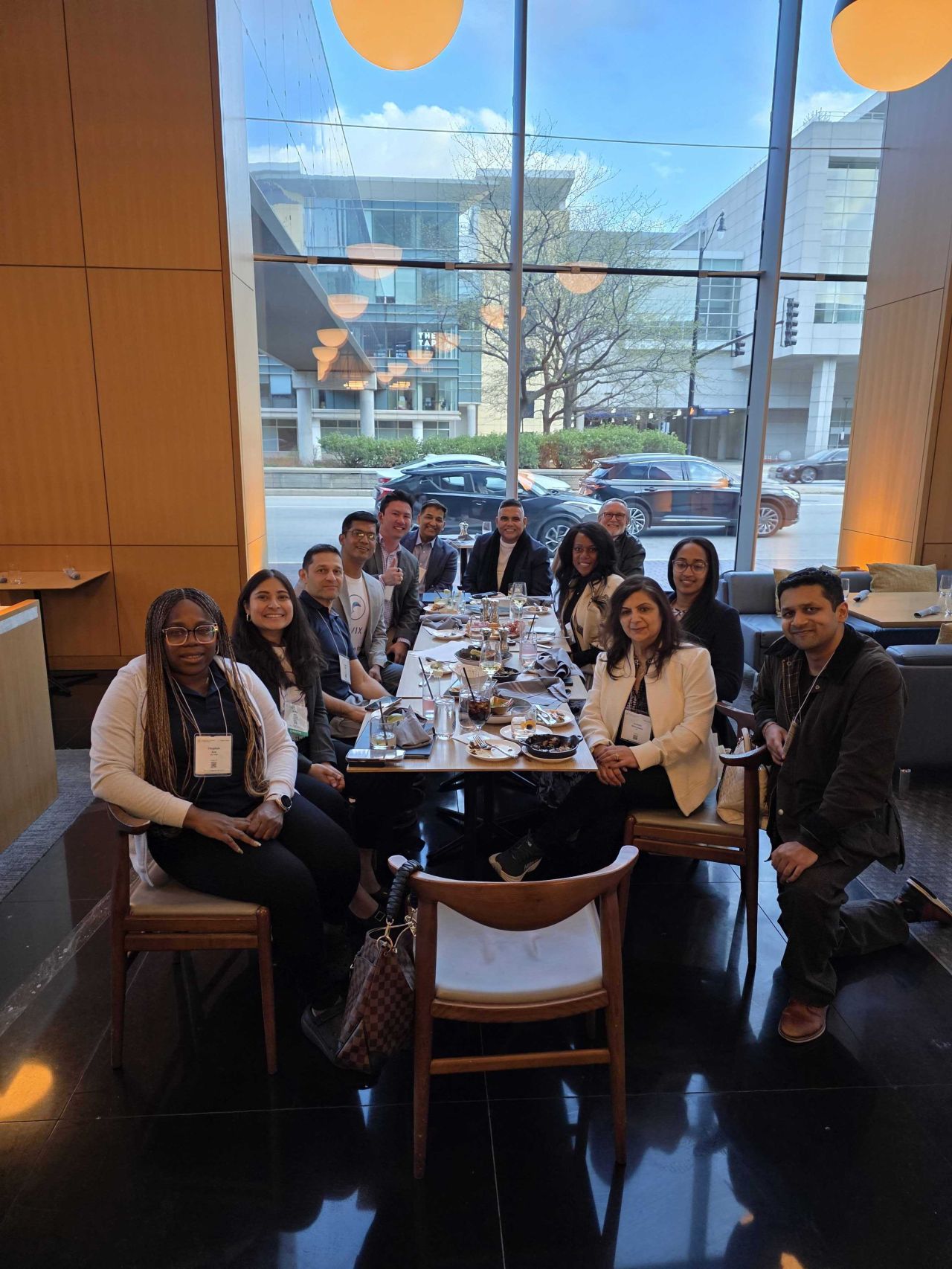
At AAN, our Ask Me Anything session brought together Dr. Hemant Pandey and Dr. Madeline Chadehumbe. What started as a structured conversation turned into something more open, with physicians in the room sharing what they had tried, what had worked, and how their thinking around AI had shifted over the past year or two.
Dr. Pandey described something during the session that stuck with everyone in the room. When a physician tries to stay present with a patient while simultaneously holding the conversation in their head for the note they will write afterward, the mental load is real even when it is hard to articulate. Since Marvix AI captures the HPI during the visit, he no longer has to do that, and he landed one of the best lines of the conference: "Earlier, the concern with AI scribes was that they might hallucinate. Now, with Marvix AI handling the scribing and the HPI seamlessly, I sometimes feel like I might end up hallucinating." It landed because everyone in the room knew exactly what he meant.
Dr. Madeline put the downstream effect in the most concrete terms heard at AAN. She now has enough time after work to plan trips to Disneyland with her kids. That says more about whether something is actually working than any time-per-note figure does.
She also raised something that stayed with us after the session ended. When a human transcriber makes an error, the usual response is a correction and some feedback. When an AI makes an error early on, the response is often sharper and sometimes ends the trial entirely. Her question was why we apply a standard to AI that we would never apply to someone we just hired. Marvix AI learns from feedback and gets more accurate the more a physician uses it, and that process requires the same patience you would extend to anyone new. Her own experience in paediatric neurology, across multiple questionnaires and child-specific assessment tools, has been that working with Marvix AI over time has made it progressively more accurate to how she actually documents.
AAN 2026 reminded us why building for a specific specialty matters. The questions neurologists asked, the depth they went to in demos, the existing customers who stopped to talk unprompted, all of it pointed to the same thing: physicians are ready for AI that actually fits how they work, and they know the difference when they see it.
Want to see what Marvix looks like for your neurology practice? The Patient Recap, the neurology-specific templates, and the EHR integration are all available in a live session. Book your 30-day free trial today.
.png)


